Margin Trading
New to Intraday Margin Trading? Start with the Professional Edge. The $25K Barrier Is Gone.
The barriers to active trading have changed. Get started with Lightspeed Trader Pro—a platform built for speed, customization, and control—and take advantage of our exclusive EDGE-40 offer when you open a qualifying account.

Lightspeed Trader Pro
Today’s markets move faster than ever. Lightspeed Trader Pro was built to support active margin traders with advanced routing tools, customizable workflows, and the responsiveness serious traders demand.

Trade with speed and precision
React to trading opportunities with custom orders and ensure your orders are executed to your specific requirements. Easily route your orders to market centers, ECNs, and dark pools with Hot Keys and Hot Buttons.
Quickly scan the market for trading opportunities
Scan the markets with LightScan and view opportunities by symbol, sorted and filtered based on your unique preferences. Stock and options scanners offer multiple possible criteria and filters to create virtually infinite possibilities.

Customize layouts to suit your trading needs
Configure up to 10 personalized screen layouts. Easily display layouts across four monitors, and quickly switch between them with a click of a button.
Sophisticated charting tools for advanced traders
Customize your charts including mouse and keyboard shortcuts, colors, candle style, and more. Trade, view and modify your open orders from the charts. Choose from over 20 indicators and customize their parameters.
New Accounts starting June 4, 2026
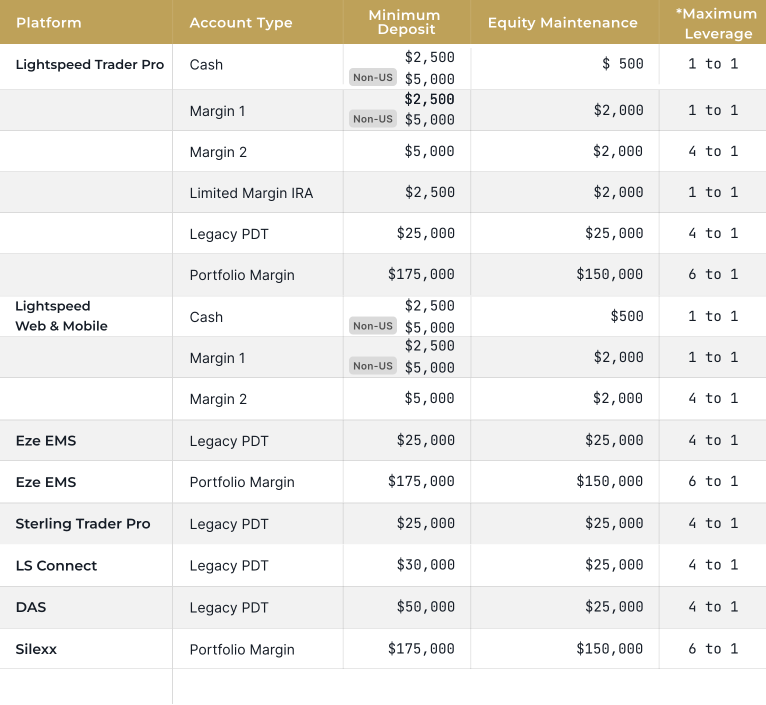
Platform Deposit Minimums for the
New Intraday Trading Requirements
The new intraday trading rule takes effect on June 4, 2026. To prepare, new Lightspeed accounts may be opened in advance, and accounts funded prior to that date will be enabled for trading once the rule becomes effective.
*Maximum Leverage in the chart below refers to
the maximum amount of leverage offered per account type. Lightspeed reserves the right to offer less leverage to new users without an established history or a defined trading strategy. Leverage will never exceed the values listed above. Contact our sales or client service team for additional information.

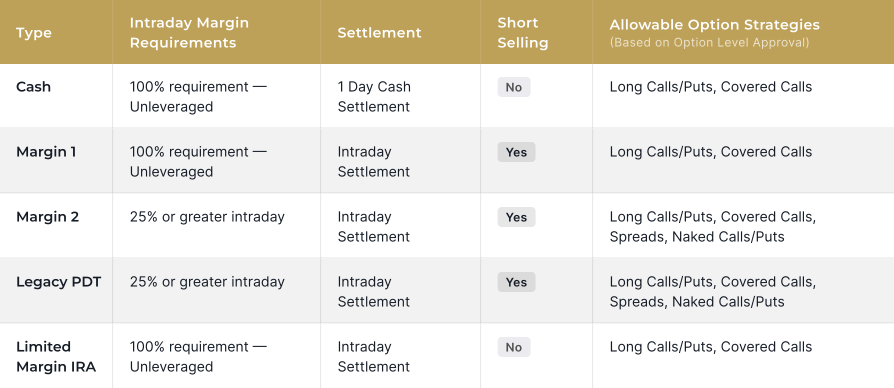

Margin Calculations
Transparent margin calculations help traders clearly understand their buying power, exposure, and risk throughout the trading day.
Access to real-time long, short, and overnight margin requirements allows traders to make more
informed decisions as market conditions change.
Long Positions
Intraday buying power for long equity positions is calculated based on account equity, regulatory requirements, and platform-specific margin allowances. Buying power may fluctuate throughout the trading day based on market movement, open positions, realized and unrealized gains or losses, and changes in margin requirements.
At Lightspeed, approved margin accounts require a minimum of $2,500 in equity to access leveraged margin trading. Once approved, accounts may continue trading on margin as long as account equity remains at or above $2,000. If the equity in any margin account falls below $2,000, trading will be restricted to closing open positions only.
MARGIN REQUIREMENTS FOR MARGIN APPROVED SECURITIES
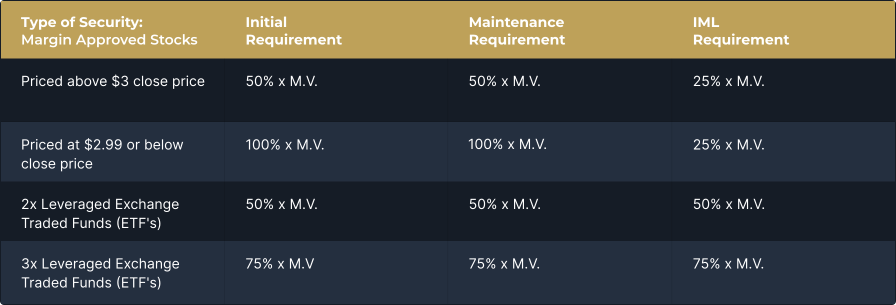
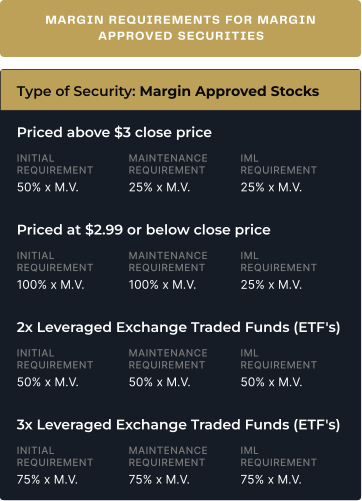

Leverage calculations may vary by security and product type. The most accurate and current leverage requirement will always be displayed directly within the trading platform, as highlighted in red in the example above.
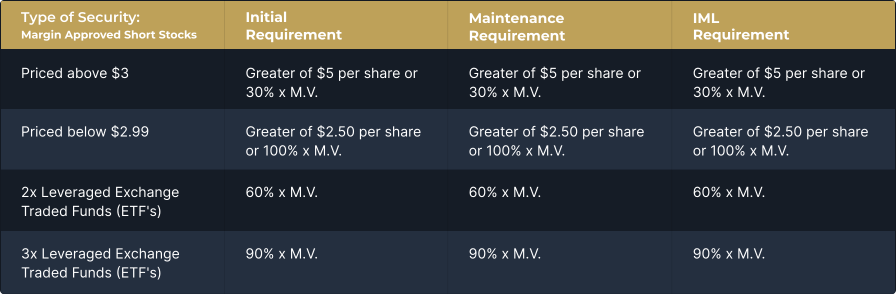
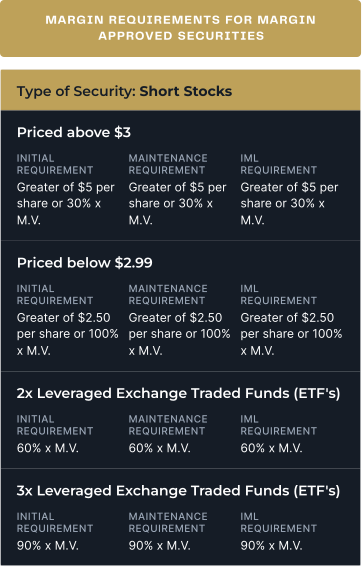
Short Positions
Overnight Positions
Positions held overnight are subject to standard overnight margin requirements, which are typically more restrictive than intraday requirements.
Accounts must maintain sufficient equity to support overnight exposure and may be subject to margin calls or liquidation if requirements are not met.
Intraday Buying Power
Buying power is dynamic and updates throughout the trading day based on several factors, including:
*Real-time market movement
*Open positions and exposure
*Executed trades
*Unrealized and realized gains/losses
*Margin requirement changes
*Concentration risk
*Regulatory and firm risk controls
As market conditions change, buying power may increase or decrease without notice.
Margin fee comparision
See How We Compare
Trade on some of the most competitive rates in the industry. Based on published rates, September 21, 2026.
Company
< $10,000
$10,000
$25K
$50K
$100K
$250K
> $1M
Lightspeed
11.25%
11.25%
11.25%
10.00%
10.00%
9.50%
8.75%
E*TRADE
12.70%
12.45%
12.20%
11.70%
11.20%
10.07%
not published
TD Ameritrade
12.075%
12.075%
11.575%
10.625%
10.575%
10.325%
not published
Please note that margin rates only apply to overnight holdings for the funds that are in excess of your account balance. There is no margin interest rate charge for day trades opened and closed in the same trading session.
Example: If you have a $30,000 account balance and you hold $40,000 worth of securities overnight, the $10,000 that you are borrowing would be subject to interest (through settlement).
You may also be interested in...

Understanding Margin Calls
Margin calls occur when an account no longer meets required equity or margin requirements due to trading activity, market movement, or insufficient buying power. Depending on the type of call, accounts may be subject to deposit requirements, trading restrictions, or liquidation if the call is not satisfied within the required timeframe.
Frequently Asked Questions
Margin trading can be complex. These FAQs are designed to help traders better understand the new intraday trading margin requirements, that role out June 4th, 2026.

Recorded Webinar
FINRA Rules & Guidance
Understanding the
New Intraday Margin Standards
FINRA has introduced new intraday margin standards under FINRA Rule 4210, effective June 4, 2026. These updates modernize margin requirements for active traders and replace the former Pattern Day Trader (PDT) framework.
Lightspeed encourages traders to review FINRA’s official educational resources to better understand the new requirements, margin accounts, and intraday buying power considerations.
FINRA Educational Resources:

Margin trading involves substantial risk and is not suitable for all investors.
Related Blogs


Day-Trading Risk Disclosure Statement
You should consider the following points before engaging in a day-trading strategy. For purposes of this notice, a “day-trading strategy” means an overall trading strategy characterized by the regular transmission by a customer of intra-day orders to effect both purchase and sale transactions in the same security or securities.
Day trading can be extremely risky.
Day trading generally is not appropriate for someone with limited resources and limited investment or trading experience and low-risk tolerance. You should be prepared to lose all of the funds that you use for day trading. In particular, you should not fund day-trading activities with retirement savings, student loans, second mortgages, emergency funds, funds set aside for purposes such as education or home ownership, or funds required to meet your living expenses. Further, certain evidence indicates that an investment of less than $50,000 will significantly impair the ability of a day trader to make a profit. Of course, an investment of $50,000 or more will in no way guarantee success.
Be cautious of claims of large profits from day trading.
You should be wary of advertisements or other statements that emphasize the potential for large profits in day trading. Day trading can also lead to large and immediate financial losses.
Day trading requires knowledge of securities markets.
Day trading requires in-depth knowledge of the securities markets and trading techniques and strategies. In attempting to profit through day trading, you must compete with professional, licensed traders employed by securities firms. You should have appropriate experience before engaging in day trading.
Day trading requires knowledge of a firm's operations.
You should be familiar with a securities firm’s business practices, including the operation of the firm’s order execution systems and procedures. Under certain market conditions, you may find it difficult or impossible to liquidate a position quickly at a reasonable price. This can occur, for example, when the market for a stock suddenly drops, or if trading is halted due to recent news events or unusual trading activity. The more volatile a stock is, the greater the likelihood that problems may be encountered in executing a transaction. In addition to normal market risks, you may experience losses due to system failures.
Day trading will generate substantial commissions, even if the per-trade cost is low.
Day trading involves aggressive trading, and generally, you will pay commissions on each trade. The total daily commissions that you pay on your trades will add to your losses or significantly reduce your earnings. For instance, assuming that a trade costs $16 and an average of 29 transactions are conducted per day, an investor would need to generate an annual profit of $111,360 just to cover commission expenses.
Day trading on margin or short selling may result in losses beyond your initial investment.
When you day trade with funds borrowed from a firm or someone else, you can lose more than the funds you originally placed at risk. A decline in the value of the securities that are purchased may require you to provide additional funds to the firm to avoid the forced sales of those securities or other securities in your account. Short selling as part of your day trading strategy also may lead to extraordinary losses, because you may have to purchase the stock at a very high price in order to cover a short position.
Potential registration requirements.
Persons providing investment advice for others or managing securities accounts for others may need to register as either an “Investment Advisor” under the Investment Advisors Act of 1940 or as a “Broker” or “Dealer” under the Securities Exchange Act of 1934. Such activities may also trigger state registration requirements.
Active Trader Commissions: Active Trader rates are not automatically applied to any account and do not automatically adjust based on monthly volume. You must contact us to request any rate changes. Rebates will not be issued for past activity. All rates are subject to ongoing review and may be increased if the client fails to meet the trade/share thresholds listed above. All stock/ETF pricing listed on this page applies to listed equities only. Option pricing assumes customer priority status..
Commissions: Accounts under $15,000 will be subject to a $25 monthly minimum commission fee, minus any actual commissions charged in the prior month. Lightspeed Trader and Sterling Trader Pro - a minimum commission charge will be applied to any order of $0.25 on any discounted per share commissions. Eze EMS (formerly RealTick) - minimum commission of $3.00 will be applied to any order. Lightspeed Web & Mobile - minimum commission of $1 will be applied to any options order. Per-share equities pricing is not available on Lightspeed Web & Mobile. All routing fees/rebates and regulatory fees are charged separately.
Commission structure does not apply to Sterling Vol Trader customers, click here for Sterling Vol Trader pricing.
Lightspeed Financial Services Group LLC is a member of FINRA, NFA and SIPC.
Stay up-to-date
Get the latest news and promos.